A stupa is a memorial – a symbol of Buddha, as the enlightenment principle, pointing indirectly to both the teacher and his teachings. It is specifically a reminder of his final passing.
 Relics divided |
 2 oldest stupas |
The stupa is by far the earliest and architecturally the most significant Buddhist expression. Burial mounds were already in use at the time of the Buddha and he suggested that a stupa be built for his remains at the intersection of four major roads – i.e. in a public place. [Mahaparinibbana Sutta (D.II.141–3)]. After his death the relics were divided into eight portions and perhaps the earliest datable stupas are those at Kusinara, site of his cremation, and the one raised by his family. Presumably these were built not long after his death. Originally stupas were little more than a mound of earth raised over the remains of saints, kings, etc. but over the centuries they have been gradually transformed into major works of art.
Stupas became a cosmic symbol in response to a major human condition: death. With the enlightenment of the Buddha stupas became a particularly Buddhist symbol.
Generally used as a repository for either a body or cremated remains. The use of non-corporeal relics is now also common. A specifically Buddhist monument used for contemplation and and as the focus of religious ritual. A symbol to inspire aspiration and efforts in the religious life – the pursuit of enlightenment.
A symmetrical expression of the microcosm and macrocosm. A centred construction designed to draw the viewer to their own still centre through silent contemplation. The basic form is a circle (heaven) inside a square (earth). The conceptual components of a stupa (cube, sphere, cone) interlock and the shared axis leads the viewer’s line of sight upwards to the apex – a symbol of the goal of Buddhism, nibbana. The pure mandala form of a stupa is best appreciated from above.
The basic elements of construction had evolved after only a few centuries of development and the main four are: the base – usually square; a ‘hemispherical’ dome; a reliquary – often on top of the dome including a spire (often a stylised umbrella) and, the jewel or crown. There is a great deal of symbolism and stylistic developments that have come to be associated with stupas.
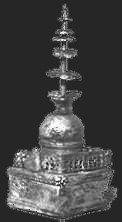 Spire as stylized umbrella |
 Sanchi |
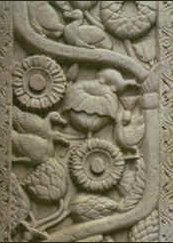 Stupa Supremo stonework details |
The main stupa at Sanchi is probably one of the best preserved ancient Indian stupas. It is a splendid example of extended construction with the original core of 18m. diam. attributed to King Asoka (c. 273 – 236 BCE). There have been a considerable number of additions and restorations carried out on the main stupa over the centuries and the site generally has several stupas and monastic remains presenting the full range of Buddhist art and architecture from the third century BCE to the twelfth CE. It was a major centre of Buddhist monasticism between 200 BCE and 600 CE. The various stupas and other monuments feature several hundred short inscriptions covering aspects of the Buddha’s teaching and details of various well known monks and nuns.
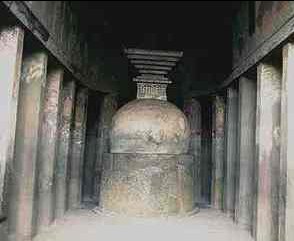
Karle cut rock
The excavation of rock-cut monasteries and temples started on a large scale in the early 2nd century BCE and each would usually contain areas for accommodation (with rock beds and pillows!), a pillared hall for monastic meetings and conducting religious ceremonies and a sanctuary which usually contained a stupa. By far the most famous of these is at Ajanta where 28 cave temples were excavated over several centuries. They are extremely well preserved.
Another famous stupa is the one at Sarnath where the Buddha gave his first discourse. Two of the first monasteries were built here during the time of the Buddha and it was the centre of a distinctive style of Buddhist art. The main stupa dates from about the 5th century CE
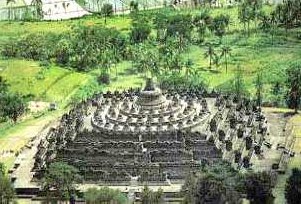
Borobudur
With construction of the Borobudur stupa beginning around 700 CE it falls very close to being considered to be a ‘recent’ stupa. However as it is the biggest Buddhist monument in the world, being both unique in style and the degree of preservation, I thought to give it the same status of the ‘grand old masters.’ Visitors ascend from the earthly plane of desire through the world of form without desire to the formless world where the summit represents the absolute. All along the way various scenes of the Buddha’s life, miniature stupas, a wealth of Buddha images and iconography create a cosmic and spiritual hierarchy which impresses itself on the mind of the pilgrim.